
Historical Context
The History of the Sahrawi
Since the 1975 invasion, the Sahrawi people have navigated a history defined by displacement and an enduring spirit of resistance in the harsh desert landscape of Tindouf.


The 1975 Conflict
The history of the Sahrawi people was irrevocably changed in 1975. Following the withdrawal of Spanish colonial forces, the territory of Western Sahara was targeted for annexation. The pivotal moment arrived with the Green March, a massive Moroccan state-sponsored demonstration involving 350,000 civilians crossing the border into the territory, backed by armed forces.
This invasion led to a swift and brutal escalation of conflict, forcing thousands of Sahrawi families to flee their ancestral homes into the desert, chased by napalm and phospherous bombs. The entry of Moroccan troops meant that the peaceful life of the Sahrawi people was replaced by a struggle for survival, marking the beginning of an era of displacement and occupation that continues to define their national identity today.
Exile in the Hammada
The 1975 invasion by Morocco, forced thousands of Sahrawi people to flee their ancestral homes. Seeking safety from the conflict, they crossed the harsh desert landscape of the Hammada, the most inhospitable part of the Sahara. This journey through the desert led to the establishment of five major refugee camps in the Tindouf province of Algeria, where they remain today, waiting for a resolution that has spanned generations.
Life in the camps is a testament to Sahrawi resilience but is fraught with systemic struggle. Food security remains precarious, with families reliant almost entirely on international aid. Education and healthcare services, while organized by the Sahrawi themselves, face chronic shortages of materials and personnel. In a landscape where temperatures exceed 50°C in the summer and -0 in the winter, the Saharawi have built a society from the sand, balancing the daily survival of their children with a persistent demand for self-determination.

Saharawi Culture: Resilience Through Heritage

The cultural identity of the Sahrawi people is deeply rooted in the nomadic traditions of the desert. Despite decades of exile, their heritage remains a vibrant force for community cohesion. Traditional arts, ranging from intricate leatherwork and weaving to the symbolic importance of the tea ceremony, serve as daily reminders of their ancestral lands. Community life is centered around collectively shared values. Hospitality was a defining value, sharing food and resources was seen as an essential obligation, this tradition continues to this day, ensuring that even in the harshest conditions, the Sahrawi spirit remains unbroken.
Music is perhaps the most potent expression of Sahrawi resistance. The songs carry the history of their displacement and their hopes for the future. Modern Sahrawi musicians combine ancient rhythms with contemporary styles to share their story with the world. In the refugee camps, poetry and song are not just entertainment; they are a living archive of a people's struggle for dignity and the preservation of a culture that refuses to be erased.
The Challenge of Food Security
The Sahrawi people living in the refugee camps of Tindouf face a perpetual struggle for food security. Situated in one of the most inhospitable environments on earth, agricultural possibilities are severely limited by extreme temperatures and lack of arable land. Consequently, over 90% of the population relies entirely on international humanitarian aid for their daily sustenance.
Decades of displacement have led to chronic malnutrition, particularly among children and pregnant women. Recent reports indicate that iron-deficiency anaemia and stunting remain major health crises within the camps. Food baskets, which typically include basic staples like flour, oil, and sugar, often lack the fresh produce and proteins necessary for a balanced diet. This dependency is further complicated by global economic shifts and funding shortfalls, which frequently result in reduced rations and increased vulnerability for thousands of families who have called these desert plains home since 1975.
Learning Against the Odds
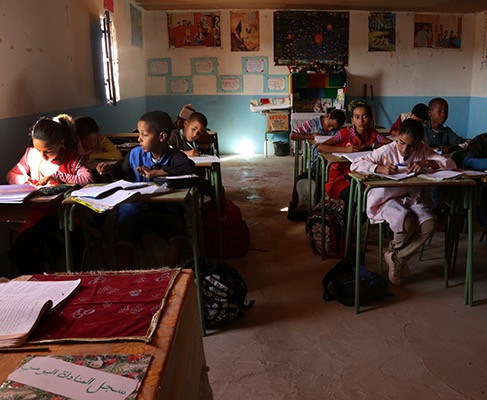
Despite the harsh desert environment, the Sahrawi people have achieved remarkable literacy rates. Education is the backbone of their resistance, with primary schools and national literacy campaigns forming the heart of camp life since the late 1970s, with over 40,000 children recieving an education at any one time. The education sector in the camps is community based and almost entirely led by the Sahrawi refugees.
The struggles remain immense; school buildings are often vulnerable to sandstorms, and there is a constant shortage of textbooks, stationery, and specialized equipment, meaning that many fail to reach their educational potential. Yet, teachers and students continue to show unwavering commitment to learning as a tool for a better future.
Healthcare in the Desert
The Sahrawi Red Crescent (MLRS) stands as the backbone of healthcare in the camps, operating under extreme conditions to provide essential services. In a landscape where the nearest major hospitals are hundreds of kilometres away, these local clinics are lifelines for thousands of families living in exile.
Despite the lack of consistent resources, the camps maintain a surprisingly structured health system. However, chronic struggles remain. Food insecurity has led to high rates of anaemia and stunting among children, while the harsh desert climate exacerbates respiratory and ophthalmological issues. Healthcare here is not just about medicine; it is about the daily resilience of doctors and nurses working with the bare minimum to preserve the dignity and life of their people.
A Future of Dignity
The story of the Sahrawi is not just one of displacement, but of unyielding resilience. From the 1975 invasion to the arduous life in the desert camps of Tindouf, the pursuit of self-determination remains strong.
Despite chronic struggles with food insecurity, limited healthcare, and the harsh climate, the Sahrawi have built an organized society focused on education and communal strength. We look forward to a future where aid is replaced by sovereignty.